


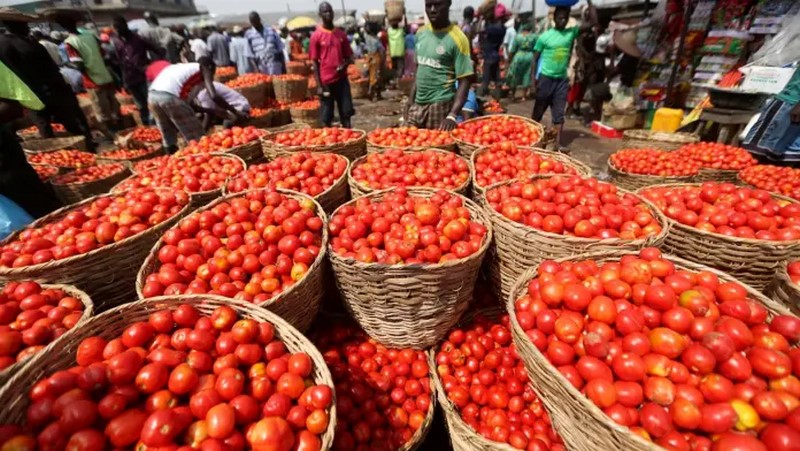

ANLOGA, VOLTA REGION — The Government of Ghana has launched the Ghana Tomato Self-Sufficiency Initiative (GHATSI) in Anloga in the Volta Region as part of efforts to increase local tomato production, reduce dependence on imports and establish a reliable year-round supply of tomatoes.
The initiative, a partnership between the Ministry of Food and Agriculture (MoFA) and FarmMate Ltd, was launched on Tuesday, September 15, 2026, at the Anlo Senior High School Park (ANSECO) in Anloga.
The launch was led by the Minister for Food and Agriculture, Eric Opoku, and brought together government officials, regional authorities, traditional leaders, farmers, financial institutions, insurers, technical partners and representatives of the media.
Initiative targets tomato import dependence
According to the Ministry of Food and Agriculture, Ghana currently spends more than US$400 million annually on imported fresh tomatoes and tomato paste, with a significant portion of the supply gap occurring during the December-to-July off-season.
GHATSI is designed to address this challenge by developing an integrated domestic tomato value chain that operates throughout the year.
The initiative will connect farmers and agricultural land with improved production systems, structured financing, irrigation, crop insurance, aggregation, industrial processing and guaranteed market access.
Government targets 400,000 tonnes annually
The full implementation of GHATSI targets 400,000 tonnes of tomatoes annually.
For the initial 2026/2027 production cycle, the programme aims to produce approximately 100,000 tonnes.
The first phase is expected to cover more than 10,000 acres across 40 districts, 12 regions and more than 100 communities, creating a production base that can be expanded in subsequent phases.
Farmers to receive production support
Under the initiative’s Farmer Enhancement Package, participating farmers are expected to receive access to financed agricultural inputs, irrigation support, extension and technical services, as well as multi-peril crop insurance.
The financing arrangement is designed to allow farmers to repay through the sale of their produce at off-take, potentially reducing some of the financial barriers associated with tomato production.
The programme will also promote contract farming and guaranteed markets to provide participating farmers with greater certainty when planning production.
Focus on jobs and reducing post-harvest losses
Beyond increasing tomato production, GHATSI is expected to create employment opportunities across the agricultural value chain, particularly in farming, aggregation, transportation, processing and distribution.
The initiative also seeks to reduce avoidable post-harvest losses and protect farmers from some of the risks associated with climate and pest shocks.
Government and its private-sector partners say the broader objective is to build a stronger domestic tomato industry capable of meeting local demand while creating opportunities for farmers and businesses.
With the launch taking place in Anloga, the Volta Region has been placed at the centre of the national push to strengthen Ghana’s tomato production and food-security efforts.


Leave a comment